RIGHT TO A HEALTHY ENVIRONMENT
RIGHT TO A HEALTHY ENVIRONMENT
WHY IN NEWS
Rising air pollution levels in Delhi–NCR, frequent enforcement of GRAP measures, and recent judicial trends linking environmental protection with fundamental rights have renewed debate on recognising an explicit constitutional right to a clean and healthy environment.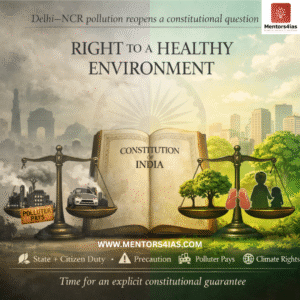
CONTEXT: INDIA’S WORSENING AIR QUALITY
- Seasonal smog in Delhi–NCR causes public health emergencies, especially in winter.
- Major sources:
- Fossil fuel combustion
- Transport emissions
- Industrial activity
- Construction and demolition
- Waste burning and agriculture
- Particulate Matter (PM) is the most lethal pollutant:
- PM10: Enters respiratory system
- 5: Penetrates lungs and bloodstream
- Diesel Particulate Matter (DPM): <1 micron, highly toxic
Regulatory Response
- Commission for Air Quality Management (CAQM) amended the Graded Response Action Plan (GRAP):
- Mandatory school closures under Phases 3 & 4
- Staggered office timings in Delhi–NCR
- Reflects shift from discretionary to mandatory preventive governance.
CONSTITUTIONAL AND JUDICIAL EVOLUTION
Article 21 and Environment
- Though the original Constitution lacked explicit environmental rights:
- Article 21 (Right to Life) expanded via judicial interpretation.
- Key judgments:
- Maneka Gandhi v. Union of India (1978) – Life includes dignity and quality
- Rural Litigation and Entitlement Kendra (1985) – Healthy environment as part of life
- C. Mehta v. Union of India (1987) – Right to pollution-free environment
- Subhash Kumar v. State of Bihar (1991) – Read Articles 48A & 51A(g) with Article 21
Directive Principles and Duties
- Article 48A: State duty to protect environment
- Article 51A(g): Citizen’s duty to safeguard nature
- Emphasises state–citizen shared responsibility.
Environmental Principles in Indian Jurisprudence
- Absolute Liability – Oleum Gas Leak case
- Precautionary Principle – Prevent harm despite scientific uncertainty
- Polluter Pays Principle – Costs borne by polluter
- Public Trust Doctrine – State as trustee of natural resources
- C. Mehta v. Kamal Nath
- Radhey Shyam Sahu – Protection of public parks
Climate Change and Fundamental Rights
- K. Ranjitsinh v. Union of India (2024):
- Recognised right against adverse climate change impacts
- Linked to Article 21 (life) and Article 14 (equality)
WAY FORWARD
- Judicial recognition alone is insufficient without explicit constitutional backing.
- Need to:
- Constitutionally guarantee the right to a clean and healthy environment
- Make state and citizens equally accountable
- Strengthen environmental governance beyond episodic judicial intervention
CONCLUSION
In an era of climate change, pollution, and ecological stress, the right to a healthy environment must evolve from an implied judicial right to an explicit constitutional guarantee, ensuring enforceability, accountability, and sustainable development.
MAINS QUESTIONS
1. Evaluate the relevance of the Polluter Pays Principle and Precautionary Principle in addressing India’s air pollution crisis.
2. How do Articles 48A and 51A(g) reflect ethical environmental stewardship in governance?