ARYAN INVASION / MIGRATION THEORY
ARYAN INVASION / MIGRATION THEORY
ARYAN INVASION / MIGRATION THEORY – MYTH OR HISTORICAL PROCESS?
Who were the Aryans?
Aryan → Term used in Vedic texts for Indo-Aryan–speaking groups + denotes linguistic–cultural identity, not race + linked to Indo-European language family.
I. Classical Aryan Invasion Theory (19th–mid-20th century)
Proponents: Sir Mortimer Wheeler, V. Gordon Childe, Stuart Piggott, Ernest Mackay, and other early European diffusionist scholars.
Core Argument: Aryans, an Indo-European pastoral group from Central Asia/West Asia, invaded north-west India c.1500 BCE, destroyed the Indus cities, and imposed Vedic language and culture.
Evidence Cited in Support
- Literary → Rigveda mentions Arya–Dasa/Dasyu conflicts + Indra called Purandara (destroyer of forts) interpreted as Harappan city destruction + absence of urban references in Rigveda contrasted with Harappan urbanism.
- Archaeological (early view) → Scattered skeletons at Mohenjodaro interpreted by Wheeler as massacre victims + urban decline after 1900 BCE seen as invasion outcome.
- Linguistic → Close similarity between Vedic Sanskrit and Avestan + Sanskrit part of Indo-European family assumed to require migration of speakers + shared myths (Indra–Vritra / Verethraghna).
- Cultural → Painted Grey Ware linked with early Vedic people + horse, chariot, spoked wheel treated as Indo-European markers.
Criticism of Aryan Invasion Theory (Modern Consensus)
Major Critics: Critiqued by George F. Dales, Kenneth A.R. Kennedy, Jim Shaffer, Gregory Possehl, B.B. Lal, Romila Thapar, R.S. Bisht, Vasant Shinde.
Evidence Against Invasion
- Archaeological refutation → No destruction layers at Harappa, Mohenjodaro, Dholavira or Kalibangan + Mohenjodaro skeletons belong to different periods and show no massacre trauma (Kennedy, 1994) + decline was gradual not violent.
- Dales (1964) → Explicitly stated there is “no evidence of any Aryan invasion or massacre in the Indus Valley.”
- Cultural continuity → Sites like Bhagwanpura, Dadheri and Manda show Late Harappan and PGW together + continuity in settlement, pottery and subsistence + rural Harappan life continued into 2nd–1st millennium BCE.
- PGW problem → If invasion occurred PGW should appear along invasion routes (Punjab, Bahawalpur), but it is confined mainly to Haryana–Upper Ganga basin, indicating regional development.
- Linguistic reinterpretation → Language similarity does not imply invasion + languages can spread via diffusion, elite dominance or long-term contact + no necessary link between language and material culture.
- Genetic evidence → Rakhigarhi DNA study (2019) shows genetic continuity with earlier South Asian populations + no large-scale population replacement around 1500 BCE + limited Steppe ancestry appears later through gradual admixture.
II. Aryan Migration Theory (Refined Model)
Proponents: Supported by Romila Thapar, Asko Parpola, David Anthony, Michael Witzel.
Core Idea: Rejects invasion and proposes small-scale, gradual Indo-Aryan migrations over centuries with cultural interaction and assimilation rather than conquest.
Supporting Evidence: Gradual linguistic diffusion + archaeological continuity + interaction between pastoral-nomadic groups and agrarian communities + Vedic culture adapted to Indian ecology rather than being imposed.
III. Indigenous / Continuity Model
Proponents: Advocated by B.B. Lal, D.P. Agrawal, R.S. Bisht, Jean-François Jarrige, Gregory Possehl.
Argument: Vedic culture evolved within the subcontinent + Harappan and post-Harappan phases represent regional diversification rather than replacement + Aryan identity is linguistic-cultural, not racial.
Archaeological Support: Cultural sequence from Mehrgarh → Kot Diji → Mature Harappa → Late Harappa → PGW shows continuity + persistence of agriculture, rituals and settlements + indigenous development of iron and pastoral-agrarian transition.
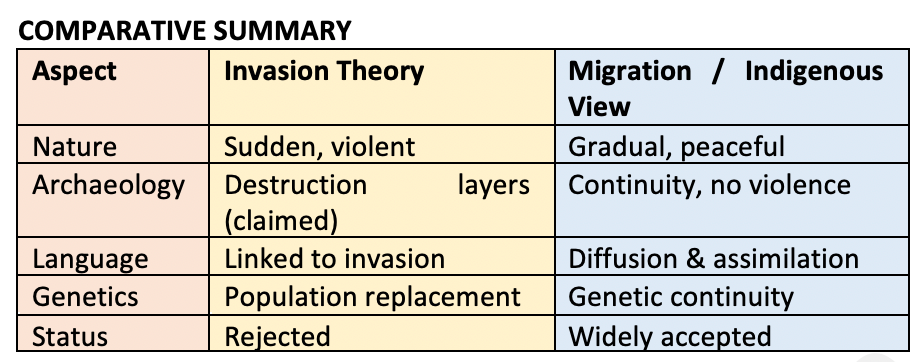
The Aryan Invasion Theory is rejected by modern archaeology, anthropology and genetics, and the Harappan–Vedic transition is best explained as a gradual process of cultural continuity, regional transformation and limited Indo-Aryan migrations, not violent replacement (Possehl).
“The Harappan Civilization did not collapse due to invasion; it de-urbanized and regionalized.” — Gregory Possehl