Published on: December 15, 2025
Movius Line Controversy
Movius Line Controversy
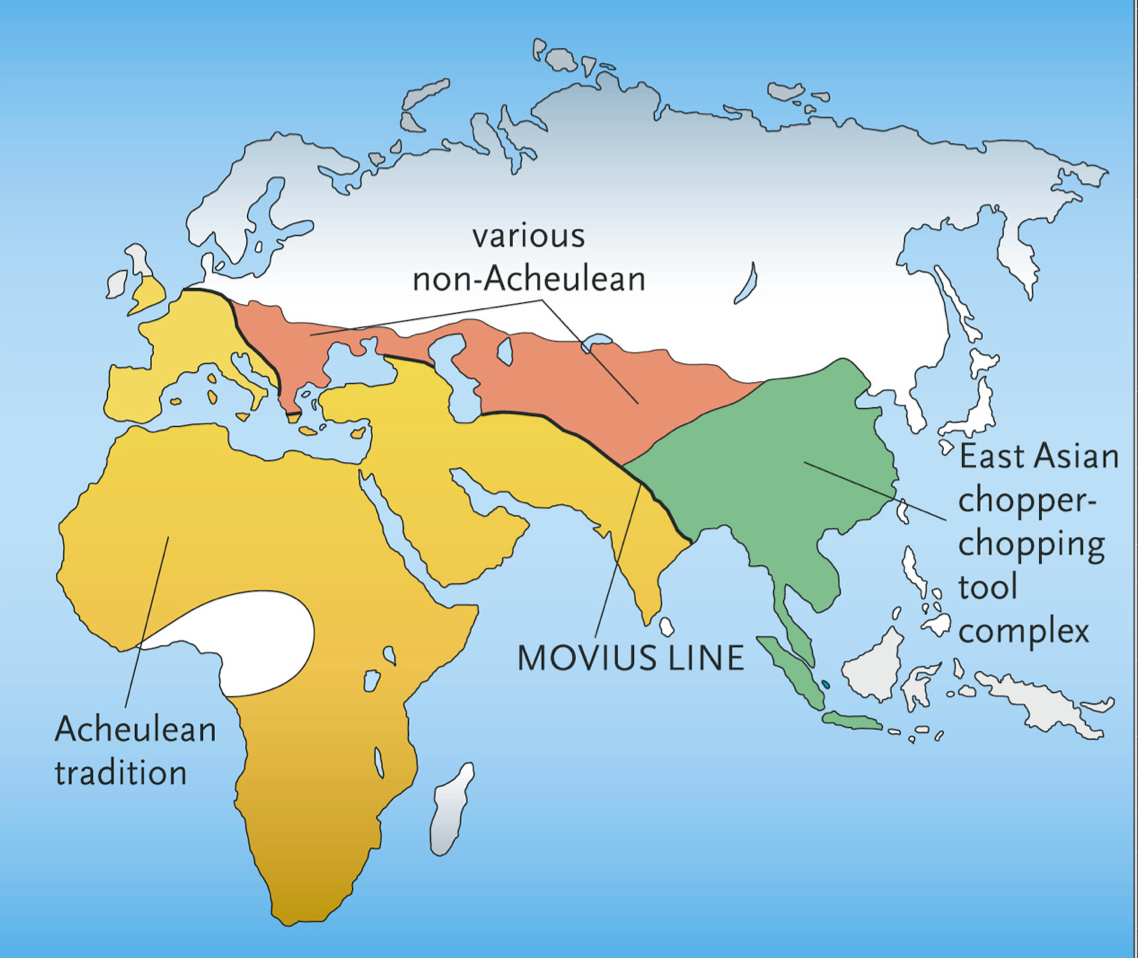
What is the Movius Line?
- The Movius Line is a hypothetical boundary proposed by Hallam L. Movius (1948).
- It separates:
- Western Old World (Africa, Europe, India) → Acheulian handaxe tradition
- Eastern Asia (China, Southeast Asia) → Chopper–chopping tool tradition
- The line roughly runs from northern India to Southeast Asia.
Basis of the Concept:
- Acheulian industries with bifacial handaxes were:
- Common in Africa, Europe, and India
- Absent or rare in East Asia
- East Asia showed dominance of:
- Pebble tools, choppers, chopping tools
- Simple core–flake industries
Explanations Proposed for the Movius Line
1. Cultural / Cognitive Explanation (Early View)
- East Asian hominins (Homo erectus) were thought to be:
- Technologically conservative
- Less cognitively advanced
- Now largely rejected as ethnocentric and biologically unsupported.
2. Raw Material Constraint Hypothesis
- East Asia lacked: Large, fine-grained stone suitable for handaxes
- Available materials (bamboo, poor-quality stone) favored: Simple flake and pebble tools
- Bamboo tools may have replaced stone handaxes.
3. Functional / Ecological Explanation
- Handaxes were not universally required.
- Tool form reflects: Subsistence strategies + Environment + Mobility patterns
- Chopper–chopping tools were sufficient for local needs.
4. Discovery Bias (Modern View)
- Acheulian handaxes have now been found east of the Movius Line: Bose Basin (China) and South China
- Indicates: The boundary is not absolute. Acheulian presence was sporadic, not absent
Why is it a “Controversy”?
- The Movius Line is no longer seen as a sharp boundary
- Instead, it represents:
- A gradient of technological variation
- Not a biological or cognitive divide
Present Consensus
- Acheulian technology: Did reach parts of East Asia + But was less frequent and uneven
- The Movius Line is now viewed as: A useful heuristic, not a rigid rule. Explaining regional diversity, not inferiority