Origin of modern symbolic behaviour
Origin of modern symbolic behaviour
Debate on the Origin of Modern Symbolic Behaviour
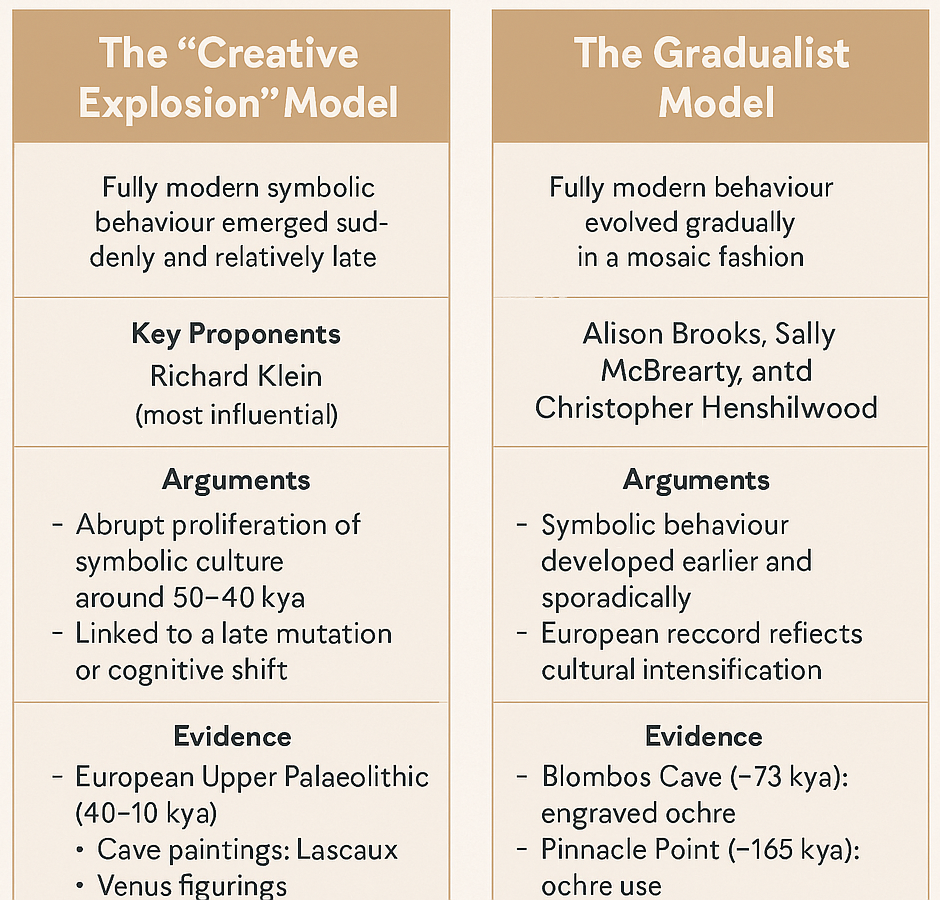
The debate over the origin of modern symbolic behaviour is central to understanding human evolution. Scholars broadly fall into two explanatory models:
- The “Creative Explosion” / Sudden Emergence Model
- The Gradualist / Mosaic Evolution Model
The “Creative Explosion” (Sudden Emergence) Model:
Core Idea: This model proposes that fully modern symbolic behaviour emerged suddenly and relatively late, due to a cognitive, neurological, or genetic change in Homo sapiens.
Key Proponents
- Richard Klein (most influential)
- Earlier support from Paul Mellars (especially based on European Upper Paleolithic)
Main Arguments
- There appears to be a time lag of nearly 100,000 years between:
- Anatomically modern Homo sapiens (~200–300 kya)
- Explosion of symbolic culture (~50–40 kya)
- True symbolic behaviour (art, ritual, ornamentation) appears abruptly and extensively in the European Upper Paleolithic.
- Suggests a late genetic mutation (possibly affecting language or neural circuitry).
Archaeological Evidence Emphasised
- European Upper Paleolithic (40–10 kya):
- Cave paintings: Lascaux, Chauvet, Altamira
- Figurative art: Venus figurines
- Advanced bone tools, needles, musical instruments
- Sudden proliferation of: Art, Symbolic burials and Complex tool traditions
Klein’s Hypothesis
- A neurological mutation (~50 kya) enabled:
- Fully syntactic language
- Abstract symbolic thought
- Cultural explosion
Criticism
- Eurocentric bias
- Over-reliance on preservation-rich European sites
- Underestimates African Middle Stone Age record
The Gradualist (Mosaic / Slow-Burn) Model:
Core Idea: Modern symbolic behaviour evolved gradually, in a mosaic fashion, long before the European Upper Paleolithic—primarily in Africa.
Key Proponents
- Sally McBrearty & Alison Brooks (2000) – landmark critique of “Human Revolution”
- Christopher Henshilwood
- Ian Tattersall (nuanced position: cognitive capacity early, expression gradual)
Main Arguments
- Cognitive capacity for symbolism arose with Homo sapiens, but:
- Expression depended on population size
- Cultural transmission
- Social complexity
- Absence of evidence ≠ evidence of absence
- Earlier models ignored African data due to:
- Poor excavation
- Taphonomic bias
Key African Case Studies (Very Important for Exams)
1. Blombos Cave, South Africa
- 100–73 kya
- Engraved ochre with geometric designs
- Shell beads → personal ornamentation
- Strong evidence of symbolic cognition
2. Pinnacle Point, South Africa
- ~165 kya
- Systematic shellfish exploitation
- Use of red ochre
- Indicates planning, dietary innovation, symbolism
3. Diepkloof Rock Shelter
- ~60 kya
- Engraved ostrich eggshell water containers
- Suggests symbolic marking + long-term planning
4. Sibudu Cave
- ~77 kya
- Compound adhesives (plant resin + ochre)
- Complex cognition and technological planning
5. Katanda, Congo
- ~90 kya
- Bone harpoons
- Advanced fishing technology
Indian and Asian Perspectives (Additions & Clarifications)
India
- Narmada Basin:
- Hominin presence (H. heidelbergensis / archaic H. sapiens)
- Limited direct symbolic evidence
- Middle Paleolithic continuity:
- Suggests behavioural persistence across climatic events (e.g., Toba eruption ~74 kya)
- Microlithic/blade industries:
- Appear both before and after 50 kya
- Suggest regional innovation, not just imported “modern package”
Asia (Additional Evidence)
- Bhimbetka (India) – early rock shelters (later symbolic evidence)
- Sulawesi cave art (Indonesia):
- Dated to ~45 kya
- Shows symbolic behaviour outside Europe, early
Current Scholarly Consensus (Updated)
- Modern behaviour did not emerge suddenly
- It evolved gradually and unevenly, primarily in Africa
- Expression became more visible after:
- Demographic expansion
- Long-distance dispersals
- European Upper Paleolithic reflects intensification, not origin
👉 Modern behaviour = biological capacity + cultural threshold