TEMPLE ARCHITECTURE AS STATE POWER
TEMPLE ARCHITECTURE AS STATE POWER
Introduction: Beyond Sacred Spaces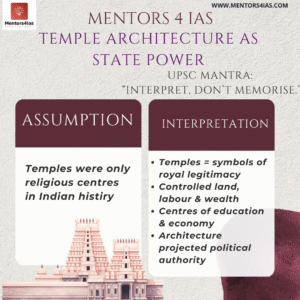
Temple architecture in ancient and early medieval India cannot be understood merely as religious expression. Temples functioned as political institutions, economic hubs, and symbols of sovereignty, enabling rulers to legitimise authority and integrate society. Architecture thus became a tool of governance and statecraft.
1. Temples as Symbols of Royal Legitimacy
a) Divine Sanction to Kingship
• Rulers projected themselves as protectors of dharma through temple patronage
• Association with major deities (Shiva, Vishnu, Devi) legitimised rule
b) Political Messaging through Inscriptions
• Temple walls recorded royal titles, genealogies, conquests
• Temples acted as permanent political proclamations
Example: Brihadisvara Temple (Chola) symbolised imperial power
2. Temples as Centres of Economic Power
a) Land Control and Revenue Generation
• Large land grants (devadana, agraharas) attached to temples
• Agricultural surplus channelled through temple institutions
b) Temple-Based Economy
• Employment of priests, artisans, dancers, scribes, labourers
• Temples functioned as treasuries and proto-banks
Impact: Economic dependence strengthened state control over regions
3. Temples as Instruments of Administration
a) Local Governance Nodes
• Village assemblies (sabha, ur) met within temple premises
• Temples facilitated interaction between state and local society
b) Territorial Integration
• Standardised architectural styles reflected political unity
• Temple networks helped consolidate expanding kingdoms
Result: Architecture reinforced administrative cohesion
4. Cultural Authority and Social Regulation
a) Control over Knowledge Systems
• Temples housed schools (ghatikas), scholars, and manuscripts
• Knowledge production aligned with state ideology
b) Reinforcement of Social Hierarchies
• Spatial organisation of temples reflected caste and social order
• Ritual access regulated social inclusion and exclusion
Effect: Power embedded within culture and ritual practice
5. Architecture as Visual Assertion of Power
a) Monumentality and Permanence
• Massive scale conveyed stability and dominance
• Stone architecture symbolised timeless authority
b) Sacred Geography
• Temples dominated urban and rural landscapes
• Created sacred-political centres of power
Message: State power portrayed as cosmic and eternal
Conclusion: Culture as Statecraft
Temple architecture was a multidimensional instrument of state power, integrating religion, economy, administration, and culture. Far from being passive religious monuments, temples actively shaped political authority and social order. Interpreting temple architecture through this lens moves us beyond rote learning to analytical history—exactly what UPSC expects.