Y-5 molar pattern — what it is and why it matters
Y-5 molar pattern — what it is and why it matters
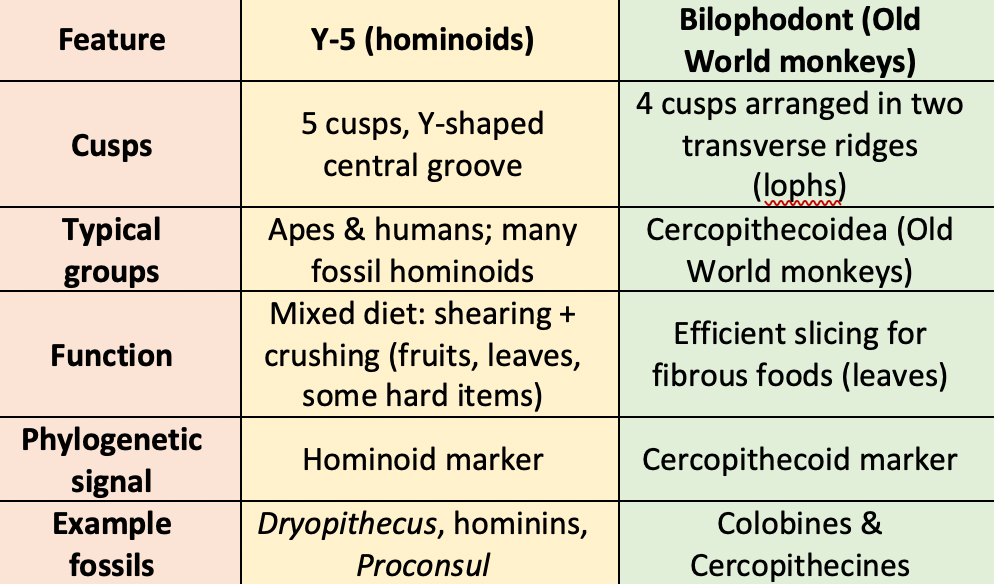
A lower molar with five cusps whose separating grooves form a Y-shaped fissure pattern on the chewing surface. The five cusps are typically named (from cheek to tongue side) but the key is the Y arrangement of the central grooves.
Characteristic of hominoids (apes and humans) and many fossil apes (e.g., Dryopithecus, Ramapithecus, Sivapithecus)
Anatomy / how to recognise
5 major cusps on a lower molar.
Central grooves converge and make a Y-shaped valley pointing toward the tongue (lingual).
Upper molars can also be Y-5 in corresponding fashion (morphology differs top/bottom).
Functional significance
The Y-5 allows a combination of crushing and shearing — good for mixed diets (fruits, soft leaves, some hard items).
Provides more complex occlusal surface to process variable foods — typical for apes with diverse diets and manipulative feeding.
Phylogenetic importance
Marker of hominoid affinity. Finding Y-5 in fossils suggests relationship to apes/humans rather than to most Old World monkeys (which tend to be bilophodont).
Example: Dryopithecus shows Y-5 → links it with hominoids; Ramapithecus and Sivapithecus also show Y-5 features.